Nice Classification · Goods class
Nice Class 23: Yarns and Threads
Yarns and threads for textile use.
Official text of Class 23 in the Nice Classification (WIPO) · NCL(13-2026)
Calculate the cost of registering your trademark in Class 23
Work out what IMPI charges to register your trademark, class by class. These are the complete official fees, with their legal basis. Our professional fees are separate and quoted per case.
- IMPI fee
This is what the government charges. Our professional fees are separate and quoted per case, because every trademark involves different work. Tell us what you want to register and we will give you a firm number.
Official fees under theAcuerdo de Tarifas IMPI (DOF 15-03-2024), artículo 14a, VAT included. Our professional fees are quoted per case and are not included. This estimate is informational and is not a formal quote or legal advice on a specific matter. USD is approximate, converted at the Banxico FIX rate of 17.5130 MXN per USD published on 24 July 2026. The peso amount is what you actually pay.
What Class 23 protects
- Yarns and threads for textile use
- Yarns of natural and synthetic fibres
- Embroidery, darning and sewing thread, including metal thread
- Glass, elastic, rubber or plastic fibres for textile use
- Spun silk, cotton and wool
What Class 23 does NOT protect
These look similar but belong to another class. Choosing wrong is the most common reason a trademark protects less than its owner believes.
- Threads for binding, of metalGoes in Class 6
- Threads for binding, not of metalGoes in Class 22
- Surgical threadGoes in Class 10
- Elastic, rubber or plastic threads, other than for textile useGoes in Class 17
- Threads of precious metal being jewelleryGoes in Class 14
The most expensive mistake in Class 23
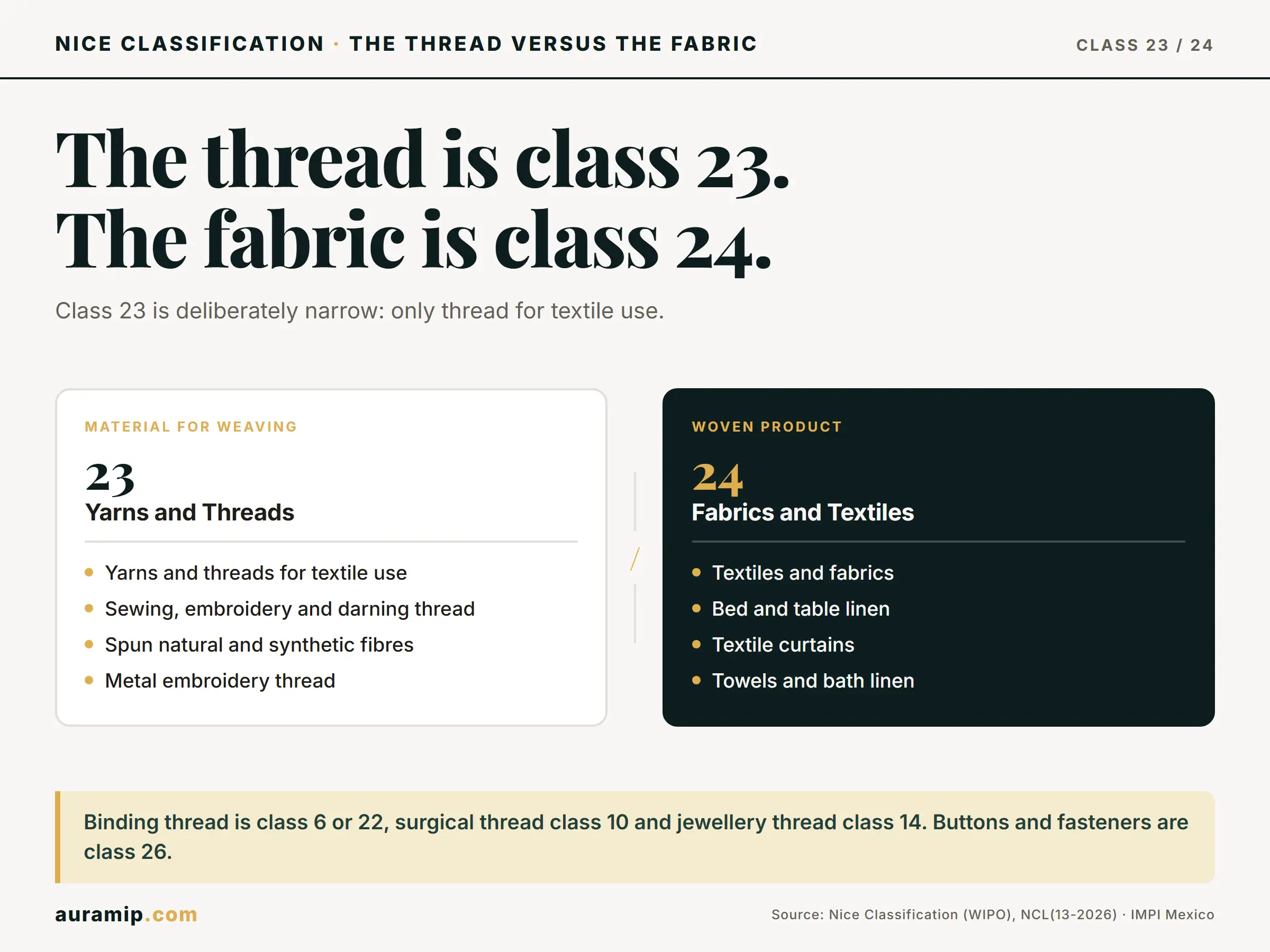
Class 23 is deliberately narrow: only thread for textile use. The same thread changes class when its use changes: for binding it is class 6 or 22 depending on the material, for surgery class 10 and for jewellery class 14. A spinning mill that also sells finished fabric needs class 24, and if it sells buttons and fasteners, class 26.
Who files in Class 23
- Sewing and embroidery thread manufacturers
- Spinning mills
- Haberdashery retailers
- Yarn manufacturers for the textile industry
- Spun synthetic fibre producers
Trademarks registered in this class: Coats, Gütermann, Omega
Classes commonly filed alongside Class 23
In Mexico each class is a separate application. Which classes you need depends on what your business actually does and how you plan to enter the market, not on the classes being related to each other. These show up in similar businesses, but the right list comes from your own activity.
Look up another Nice class
Each class protects different things. Check the one that matches your business.
Goods classes (1 to 34)
- 1Chemicals
- 2Paints and Varnishes
- 3Cosmetics and Cleaning
- 4Oils and Fuels
- 5Pharmaceuticals
- 6Raw Metals
- 7Machinery
- 8Hand Tools
- 9Software and Electronics
- 10Medical Instruments
- 11Lighting Apparatus
- 12Vehicles
- 13Firearms
- 14Jewellery
- 15Musical Instruments
- 16Paper and Printing
- 17Rubber and Plastics
- 18Leather Goods
- 19Building Materials
- 20Furniture
- 21Household Utensils
- 22Ropes and Fibres
- 23Yarns and Threads
- 24Fabrics and Textiles
- 25Clothing and Footwear
- 26Haberdashery
- 27Carpets
- 28Games and Toys
- 29Processed Foods
- 30Staple Foods
- 31Agricultural Products
- 32Beers and Beverages
- 33Alcoholic Beverages
- 34Tobacco
Services classes (35 to 45)
Not sure which class you need?
A wrongly chosen class cannot be fixed later: you refile and you pay again. We review your case and tell you exactly which classes your trademark belongs in before anything is filed.
Request a class review